
Quick Navigation
I’ve been fascinated by urban design for a long time, and the more I learn about it, the more I keep coming back to one unexpected idea: hexagons might be the smartest shape we’re not using enough in city planning. Hear me out, because this goes deeper than geometry class.
It Starts With Bees
It actually starts with bees. Bees have been solving one of the same core problems that city planners wrestle with — how do you fit the most into the least space, using the least material? For bees, the math is brutal. They need eight units of honey just to produce one unit of wax. So every bit of wax has to count. After millions of years of evolutionary pressure, their answer is the hexagonal honeycomb, and it’s not a coincidence. Among all the shapes that can tile a surface without leaving gaps — triangles, squares, hexagons — the hexagon gives the most area for the least wall. Nature stress-tested this problem for millions of years and kept arriving at the same answer.
What Biomimicry Actually Means
This is what biomimicry is all about. Instead of inventing solutions from scratch, you look at what nature already figured out. And when it comes to organizing dense, efficient space, nature’s answer is remarkably consistent. Snowflakes form on hexagonal crystal lattices. Graphene — hexagonally arranged carbon atoms — is roughly a hundred times stronger than steel. Honeycomb paneling is used in aircraft wings and rockets because it is simultaneously strong, light, and flexible. Nature keeps returning to the hexagon not out of habit, but because the physics keep demanding it.
What’s Actually Wrong With the Grid
So what does this have to do with cities? Well, the rectangular grid that underpins most of our major cities — Manhattan, Chicago, San Francisco — has some real structural problems that don’t get talked about enough. The grid looks orderly and logical, but it quietly distorts how space works. Move horizontally or vertically one block and you’ve traveled one unit of distance. Move diagonally and you’ve actually traveled the square root of two — about 1.4 units. The grid looks even, but the geometry is working against you the whole time. There’s also research suggesting that monotonous grid environments have measurable negative effects on well-being, generating stress and lowered positive affect. Boring environments, it turns out, aren’t just dull — they’re actually bad for us.
Why Hexagons Fix It
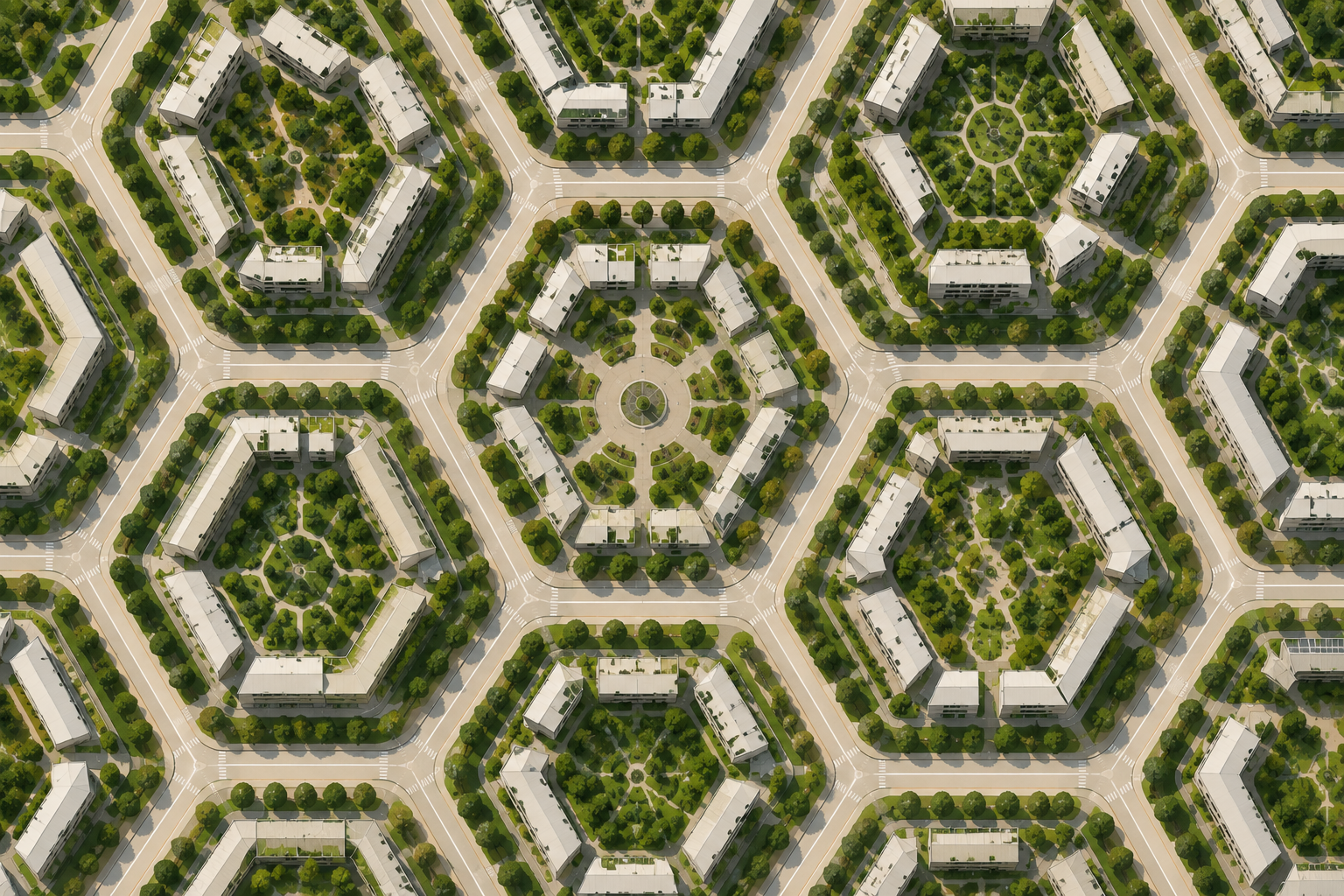
Hexagonal city plans solve a lot of this. They’ve been shown in comparative analyses to improve travel efficiency, increase exposure to direct sunlight, and even improve safety. The reason comes back to the same geometry that makes honeycombs work. A hexagon has six equidistant neighbors — every adjacent cell is exactly one step away in any direction, with no diagonal distortion. Routes become more direct, access becomes more equitable across the city, and the whole network just flows better.
The Strength Argument
There’s a structural case to be made too. When hexagons join together, they form joints set 120 degrees apart — the most mechanically stable arrangement possible for the least material. Translated into urban infrastructure, that kind of distributed stability means a network that handles stress without concentrating it in weak points. One designer who experimented with hexagonal city layouts described using larger hexagons subdivided into organic street patterns, with commercial zones at the outer edges and residential areas toward the center. The result worked so naturally it was almost unremarkable — which, honestly, might be the highest compliment you can give a city plan.
Cities Are Already Starting to Catch On
We’re already seeing hints of this thinking in practice. Barcelona has been implementing superblocks — condensing several small grid blocks into larger ones, cutting car access and creating more human-centered gathering space. It’s not a full hexagonal grid, but it’s the same underlying instinct: break the tyranny of the rigid rectangle and give space back to people.
The bees didn’t study architecture. They just followed the physics until nothing better was left. Our cities could use a little more of that logic.
