Quick Navigation
The Johari Window is one of the most enduring frameworks in psychology and leadership development — and for good reason. Developed in 1955 by psychologists Joseph Luft and Harry Ingham (the name “Johari” is a blend of their first names), the model offers a deceptively simple way to visualize self-awareness, interpersonal trust, and the blind spots that quietly shape every relationship we have.
What Is the Johari Window?
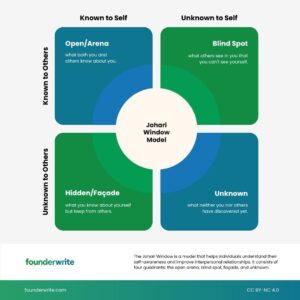
The Johari Window is a communication and feedback model that maps the relationship between what you know about yourself and what others know about you. It depicts a four-paned “window,” where the two columns represent the selfand the two rows represent others in your group or relationship.
The size of each pane is not fixed. As trust grows and information is exchanged — through honest feedback and genuine self-disclosure — the panes shift and reshape, like a living window that adjusts to the relationship you’re building.
The Four Quadrants Explained
1. The Open Area (Arena)
What it is: Information known both to you and to others.
The Open Area is the foundation of productive communication. It contains your visible behaviors, opinions, values, and feelings — everything you openly share and that others can observe. Think of it as the “above the surface” portion of the iceberg. The larger this area, the more authentic and efficient your interactions become.
The goal of every personal development or team-building effort using this model is to grow the Open Area. Greater openness leads to less guesswork, fewer misunderstandings, and deeper trust.
In practice: Factual conversation, your stated opinions on work projects, your working style, how you respond under pressure — all the things colleagues and friends genuinely know about you.
2. The Blind Spot
What it is: Information others can see about you that you are unaware of.
Often called the “bad breath” quadrant — named for the classic example of something people around you notice but rarely tell you directly — the Blind Spot contains behaviors, habits, mannerisms, and patterns you unknowingly communicate to others. It could be the way you dominate meetings, talk over others, or give off signals of disengagement that you never intended.
The Blind Spot is reduced through feedback. When someone notices something and tells you, that information moves into the Open Area. When they notice it but stay quiet, everything stays the same.
For people with large Blind Spots, learning to actively solicit feedback can be genuinely surprising — and enlightening.
3. The Hidden Area (Façade)
What it is: Information you know about yourself but choose not to share.
The Hidden Area holds your private thoughts, fears, insecurities, past experiences, and feelings you’re not ready to reveal. People maintain a Façade for many reasons: fear of rejection or ridicule, a desire to project a certain image, or simply a lack of trust in those around them.
The larger the Hidden Area, the less likely relationships are to progress beyond surface-level acquaintance. The Façade shrinks through self-disclosure — when you trust someone enough to share something personal, that information crosses into the Open Area, and the relationship deepens.
4. The Unknown
What it is: Information neither you nor others are aware of.
The Unknown quadrant contains untapped potential, deeply buried memories, unconscious drives, and undiscovered talents. Some of this material may be so far below the surface it’s never fully accessible — the Freudian unconscious, in essence. But other parts can be surfaced through shared discovery and new experiences: taking on a challenge you’ve never faced, public speaking for the first time, traveling somewhere unfamiliar.
The Unknown shrinks through self-discovery and the insights that emerge when you push past your comfort zone.
The Goal: Grow the Open Area
The entire framework points toward one objective — expanding the Open Area by:
- Seeking feedback to reduce the Blind Spot (move the vertical divider right)
- Self-disclosing to reduce the Hidden Area (move the horizontal divider down)
- Exploring new experiences to reduce the Unknown
When both happen together, the Open Area grows in all directions. The Blind Spot shrinks as others help you see what you can’t. The Façade shrinks as you trust enough to be vulnerable. The result, according to Luft and Ingham, is not just better communication — it’s a more accepting relationship with yourself and others.
Four Personality Profiles in the Johari Window
Not everyone uses the model in balance. Four archetypal profiles emerge from the ratios of the panes:
The Ideal Window has a large Arena and small Blind Spot, Façade, and Unknown. This person is easy to understand, honest in relationships, and comfortable both giving and receiving feedback.
The Interviewer has a large Façade and small Arena. They’re comfortable asking questions but reluctant to share anything personal. Others may eventually find them frustrating, even untrustworthy, because it’s hard to know where they stand.
The Bull-in-a-China-Shop has a large Blind Spot. They share freely but rarely ask for feedback, so they remain unaware of how their behavior lands. They may be perceived as insensitive or critical — not out of malice, but out of genuine unawareness.
The Turtle has a large Unknown and gives nothing away. Silent observers, they neither seek feedback nor disclose. The energy required to maintain such a closed system leaves little room for growth.
How to Use the Johari Window in Practice
For individuals:
- Identify your adjectives — what words describe you to yourself? What would others add?
- Ask for specific, behavioral feedback from people you trust
- Practice sharing something personal that feels slightly uncomfortable
- Take on a new experience specifically to surface unknown strengths
For teams and leaders:
- Use structured feedback exercises to normalize candor
- Create psychological safety so team members can disclose without fear
- Acknowledge your own Blind Spots publicly — it models vulnerability for others
- Treat feedback not as criticism but as information moving from shadow to light
Why the Johari Window Still Matters
Decades after Luft and Ingham introduced it, the Johari Window remains a cornerstone of leadership development, therapy, and team dynamics because its core insight is timeless: most friction in relationships comes from the gaps between what we think we’re showing and what others actually see. Closing those gaps — through courage, curiosity, and honest conversation — is the work of becoming someone others can truly know.