<?xml version="1.0" encoding="UTF-8"?><feed
	xmlns="http://www.w3.org/2005/Atom"
	xmlns:thr="http://purl.org/syndication/thread/1.0"
	xml:lang="en-US"
	>
	<title type="text">Founderwrite</title>
	<subtitle type="text"></subtitle>

	<updated>2026-05-19T11:17:52Z</updated>

	<link rel="alternate" type="text/html" href="https://founderwrite.com" />
	<id>https://founderwrite.com/feed/atom/</id>
	<link rel="self" type="application/atom+xml" href="https://founderwrite.com/feed/atom/" />

	<generator uri="https://wordpress.org/" version="7.0.2">WordPress</generator>
<icon>https://founderwrite.com/wp-content/uploads/2025/08/fw-logo-e1755242656301.png</icon>
	<entry>
		<author>
			<name>Founderwrite</name>
							<uri>https://founderwrite.com</uri>
						</author>

		<title type="html"><![CDATA[Why Hexagons Might Be the Future of City Planning (And What Bees Have to Do With It)]]></title>
		<link rel="alternate" type="text/html" href="https://founderwrite.com/why-hexagons-are-the-future-of-city-planning/" />

		<id>https://founderwrite.com/?p=21974</id>
		<updated>2026-05-19T11:17:52Z</updated>
		<published>2026-05-17T21:46:31Z</published>
		<category scheme="https://founderwrite.com" term="City Planning" /><category scheme="https://founderwrite.com" term="Cityology" />
		<summary type="html"><![CDATA[I&#8217;ve been fascinated by urban design for a long time, and the more I learn about it, the more I&#8230;]]></summary>

					<content type="html" xml:base="https://founderwrite.com/why-hexagons-are-the-future-of-city-planning/"><![CDATA[<p class="font-claude-response-body break-words whitespace-normal leading-[1.7]">I&#8217;ve been fascinated by urban design for a long time, and the more I learn about it, the more I keep coming back to one unexpected idea: hexagons might be the smartest shape we&#8217;re not using enough in city planning. Hear me out, because this goes deeper than geometry class.</p>
<h3 class="text-text-100 mt-3 -mb-1 text-[1.125rem] font-bold">It Starts With Bees</h3>
<p class="font-claude-response-body break-words whitespace-normal leading-[1.7]">It actually starts with bees. Bees have been solving one of the same core problems that city planners wrestle with — how do you fit the most into the least space, using the least material? For bees, the math is brutal. They need eight units of honey just to produce one unit of wax. So every bit of wax has to count. After millions of years of evolutionary pressure, their answer is the hexagonal honeycomb, and it&#8217;s not a coincidence. Among all the shapes that can tile a surface without leaving gaps — triangles, squares, hexagons — the hexagon gives the most area for the least wall. Nature stress-tested this problem for millions of years and kept arriving at the same answer.</p>
<h3 class="text-text-100 mt-3 -mb-1 text-[1.125rem] font-bold">What Biomimicry Actually Means</h3>
<p class="font-claude-response-body break-words whitespace-normal leading-[1.7]">This is what biomimicry is all about. Instead of inventing solutions from scratch, you look at what nature already figured out. And when it comes to organizing dense, efficient space, nature&#8217;s answer is remarkably consistent. Snowflakes form on hexagonal crystal lattices. Graphene — hexagonally arranged carbon atoms — is roughly a hundred times stronger than steel. Honeycomb paneling is used in aircraft wings and rockets because it is simultaneously strong, light, and flexible. Nature keeps returning to the hexagon not out of habit, but because the physics keep demanding it.</p>
<h3 class="text-text-100 mt-3 -mb-1 text-[1.125rem] font-bold">What&#8217;s Actually Wrong With the Grid</h3>
<p class="font-claude-response-body break-words whitespace-normal leading-[1.7]">So what does this have to do with cities? Well, the rectangular grid that underpins most of our major cities — Manhattan, Chicago, San Francisco — has some real structural problems that don&#8217;t get talked about enough. The grid looks orderly and logical, but it quietly distorts how space works. Move horizontally or vertically one block and you&#8217;ve traveled one unit of distance. Move diagonally and you&#8217;ve actually traveled the square root of two — about 1.4 units. The grid looks even, but the geometry is working against you the whole time. There&#8217;s also research suggesting that monotonous grid environments have measurable negative effects on well-being, generating stress and lowered positive affect. Boring environments, it turns out, aren&#8217;t just dull — they&#8217;re actually bad for us.</p>
<h3 class="text-text-100 mt-3 -mb-1 text-[1.125rem] font-bold">Why Hexagons Fix It</h3>
<p class="font-claude-response-body break-words whitespace-normal leading-[1.7]">Hexagonal city plans solve a lot of this. They&#8217;ve been shown in comparative analyses to improve travel efficiency, increase exposure to direct sunlight, and even improve safety. The reason comes back to the same geometry that makes honeycombs work. A hexagon has six equidistant neighbors — every adjacent cell is exactly one step away in any direction, with no diagonal distortion. Routes become more direct, access becomes more equitable across the city, and the whole network just flows better.</p>
<h3 class="text-text-100 mt-3 -mb-1 text-[1.125rem] font-bold">The Strength Argument</h3>
<p class="font-claude-response-body break-words whitespace-normal leading-[1.7]">There&#8217;s a structural case to be made too. When hexagons join together, they form joints set 120 degrees apart — the most mechanically stable arrangement possible for the least material. Translated into urban infrastructure, that kind of distributed stability means a network that handles stress without concentrating it in weak points. One designer who experimented with hexagonal city layouts described using larger hexagons subdivided into organic street patterns, with commercial zones at the outer edges and residential areas toward the center. The result worked so naturally it was almost unremarkable — which, honestly, might be the highest compliment you can give a city plan.</p>
<h3 class="text-text-100 mt-3 -mb-1 text-[1.125rem] font-bold">Cities Are Already Starting to Catch On</h3>
<p class="font-claude-response-body break-words whitespace-normal leading-[1.7]">We&#8217;re already seeing hints of this thinking in practice. Barcelona has been implementing superblocks — condensing several small grid blocks into larger ones, cutting car access and creating more human-centered gathering space. It&#8217;s not a full hexagonal grid, but it&#8217;s the same underlying instinct: break the tyranny of the rigid rectangle and give space back to people.</p>
<p class="font-claude-response-body break-words whitespace-normal leading-[1.7]">The bees didn&#8217;t study architecture. They just followed the physics until nothing better was left. Our cities could use a little more of that logic.</p>
]]></content>
		
			</entry>
		<entry>
		<author>
			<name>Founderwrite</name>
							<uri>https://founderwrite.com</uri>
						</author>

		<title type="html"><![CDATA[Every Major Street Pattern Explained (And What They Get Right and Wrong)]]></title>
		<link rel="alternate" type="text/html" href="https://founderwrite.com/every-major-street-pattern-explained/" />

		<id>https://founderwrite.com/?p=21975</id>
		<updated>2026-05-17T22:00:56Z</updated>
		<published>2026-05-17T21:34:56Z</published>
		<category scheme="https://founderwrite.com" term="City Planning" /><category scheme="https://founderwrite.com" term="Cityology" />
		<summary type="html"><![CDATA[I&#8217;ve spent a lot of time thinking about how cities are laid out, and one thing that always strikes me&#8230;]]></summary>

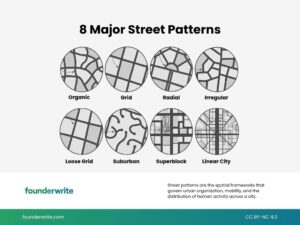
					<content type="html" xml:base="https://founderwrite.com/every-major-street-pattern-explained/"><![CDATA[<p class="font-claude-response-body break-words whitespace-normal leading-[1.7]">I&#8217;ve spent a lot of time thinking about how cities are laid out, and one thing that always strikes me is how much the shape of your streets determines the shape of your life. Where you can walk, how long your commute takes, whether you know your neighbors — it all traces back to decisions made by planners, sometimes hundreds of years ago. Here&#8217;s a breakdown of every major street pattern and what you actually need to know about each one.</p>
<h3 class="text-text-100 mt-3 -mb-1 text-[1.125rem] font-bold">The Organic Pattern: Beautiful Chaos</h3>
<p class="font-claude-response-body break-words whitespace-normal leading-[1.7]">Think of Venice. Those streets didn&#8217;t come from a planning meeting — they grew over hundreds of years around waterways, bridges, and small islands. Nobody sat down and designed it. Necessity and geography did all the work, and the result is narrow winding streets that sometimes end in dead ends and sometimes open up to surprising little squares.</p>
<p class="font-claude-response-body break-words whitespace-normal leading-[1.7]">The charm is real. At every corner you might find a new bakery, a small shop, or an unexpected view. GPS gets confused. Tourists get lost. And somehow that&#8217;s exactly the point — there&#8217;s an escape from predictability that you just can&#8217;t manufacture.</p>
<p class="font-claude-response-body break-words whitespace-normal leading-[1.7]">Cities like Fez&#8217;s Medina, Istanbul&#8217;s historic districts, and Tokyo&#8217;s old neighborhoods all developed this way. People settled first, and the streets took shape around their lives. Modern urban planners are actually trying hard to preserve these patterns now, because the research is clear: organic streets support social life, strengthen neighborhood relationships, and help local businesses thrive. The downside is that infrastructure development is a nightmare. You can&#8217;t easily run water pipes and electrical cables through streets that were never designed to accommodate them.</p>
<h3 class="text-text-100 mt-3 -mb-1 text-[1.125rem] font-bold">The Grid Pattern: Simple, Powerful, Flawed</h3>
<p class="font-claude-response-body break-words whitespace-normal leading-[1.7]">When you look at Chandigarh from the air, you see a perfect chessboard. Manhattan works on the same logic. The old New York planners said &#8220;simple is beautiful&#8221; in 1811, and they weren&#8217;t entirely wrong. Finding an address is easy. Emergency services can reach anywhere quickly because they already know the roads. Infrastructure is straightforward because everything follows the same repeatable logic.</p>
<p class="font-claude-response-body break-words whitespace-normal leading-[1.7]">But the grid has real problems that don&#8217;t get discussed enough. Wind corridors form between tall buildings. Every corner starts to look like the last. And geometrically, the grid quietly works against you — move one block horizontally or vertically and you&#8217;ve traveled one unit of distance, but cut diagonally and you&#8217;ve actually covered about 1.4 units. The grid looks even, but the math says otherwise. Modern grid cities try to patch this with parks, squares, and buildings of varying heights — Chicago and Barcelona being good examples of this hybrid approach.</p>
<h3 class="text-text-100 mt-3 -mb-1 text-[1.125rem] font-bold">The Radial Pattern: Everything Leads to the Center</h3>
<p class="font-claude-response-body break-words whitespace-normal leading-[1.7]">Moscow, Paris, Washington D.C. — these cities spread outward from a central point like a star. Twelve streets radiate from the Arc de Triomphe. All roads lead to Red Square. The logic is elegant: access to the whole city flows from one important center, which stays lively and commercially vibrant because of it.</p>
<p class="font-claude-response-body break-words whitespace-normal leading-[1.7]">The problem is that the center becomes suffocating. Traffic congestion gets serious, and moving between neighborhoods is oddly difficult because there are often no direct connections between them. To get from point A to point B, you sometimes have to go through the center, which makes no practical sense. Most radial cities have tried to solve this with ring roads — Moscow&#8217;s MKA and Paris&#8217;s Périphérique were both built for exactly this reason.</p>
<h3 class="text-text-100 mt-3 -mb-1 text-[1.125rem] font-bold">The Irregular Pattern: Geography Wins</h3>
<p class="font-claude-response-body break-words whitespace-normal leading-[1.7]">San Francisco&#8217;s streets climb hills, cut through grids, hit 40-degree inclines, and then level out and start gridding again. The reason is simple: when the city was founded, planners decided to ignore the topography and impose a grid anyway. The result is Lombard Street and some of the most famous car chase scenes in cinema history.</p>
<p class="font-claude-response-body break-words whitespace-normal leading-[1.7]">Most cities are actually irregular when you look closely. Istanbul has the Bosphorus and hills pulling everything in different directions. Rio, Hong Kong, and Seattle all have similar mixed structures — visually rich and distinctive, but genuinely hard to navigate and expensive to maintain because each neighborhood requires completely different infrastructure solutions.</p>
<h3 class="text-text-100 mt-3 -mb-1 text-[1.125rem] font-bold">The Loose Grid: The Sweet Spot</h3>
<p class="font-claude-response-body break-words whitespace-normal leading-[1.7]">Buenos Aires has a grid, but it isn&#8217;t rigid like Chandigarh&#8217;s. Some streets are wider, some blocks are different sizes, and diagonal streets cut through to break things up and ease traffic. Melbourne uses the same system and does it really well. The city is practical without being monotonous, and there&#8217;s enough variation to carve out parks and public squares naturally.</p>
<p class="font-claude-response-body break-words whitespace-normal leading-[1.7]">This is honestly the pattern most urban planners quietly prefer. It&#8217;s orderly without being boring. It&#8217;s designed at a human scale. Portland, Adelaide, and Savannah all use variations of this approach, and it tends to work especially well in walkable, mild-climate cities. It&#8217;s also naturally bike-friendly in a way that strict grids rarely are.</p>
<h3 class="text-text-100 mt-3 -mb-1 text-[1.125rem] font-bold">The Suburban Pattern: Built for Cars, Not People</h3>
<p class="font-claude-response-body break-words whitespace-normal leading-[1.7]">Auckland is almost impossible to live in without a car. That&#8217;s by design. Wide streets, large houses with gardens, curved roads with lots of dead ends — everything was built around the assumption that every family would own a car. Phoenix, Atlanta, Houston, and Las Vegas all follow this same model, and it&#8217;s entirely a product of the 1950s car boom.</p>
<p class="font-claude-response-body break-words whitespace-normal leading-[1.7]">The costs are real: hours in traffic, high fuel expenses, environmental pollution, and a kind of social isolation that comes from streets where you almost never run into a neighbor by accident. The benefits are also real — spacious homes, quiet streets, low crime rates, and safe space for kids to play. Modern suburbs are trying to retrofit bike lanes and public transit into all of this, but it&#8217;s genuinely hard to undo infrastructure that was built from scratch around the car.</p>
<h3 class="text-text-100 mt-3 -mb-1 text-[1.125rem] font-bold">The Superblock: Reclaiming the Street</h3>
<p class="font-claude-response-body break-words whitespace-normal leading-[1.7]">Barcelona&#8217;s superblock experiment has gotten a lot of attention, and for good reason. Nine normal city blocks get combined into one giant superblock. Cars are gone from the interior. Pedestrians, cyclists, and kids playing in the street take over. Old parking lots become parks and gardens. Cafes open up on what used to be through streets.</p>
<p class="font-claude-response-body break-words whitespace-normal leading-[1.7]">The results have been measurable — cleaner air, quieter streets, increased safety, and surprisingly, a boost for local businesses because people are more comfortable spending time outside. Copenhagen and Ghent are running similar experiments with similarly positive results. The main criticism is that surrounding roads absorb more traffic, which is a legitimate concern. When Barcelona first rolled it out, the backlash was significant. But the data won people over. Paris&#8217;s 15-minute city concept follows the same underlying logic — meet all your daily needs without long-distance travel — and it&#8217;s becoming one of the more serious tools cities have for fighting car dependence and climate change.</p>
<h3 class="text-text-100 mt-3 -mb-1 text-[1.125rem] font-bold">The Linear City: The Wildcard</h3>
<p class="font-claude-response-body break-words whitespace-normal leading-[1.7]">Saudi Arabia&#8217;s NEOM project — called The Line — is a straight city 170 kilometers long designed to hold 9 million people. It sounds like science fiction, but the linear city concept actually dates back to the 1800s, when Spanish architect Arturo Soria y Mata first proposed it and built a small section in Madrid.</p>
<p class="font-claude-response-body break-words whitespace-normal leading-[1.7]">The idea is that transportation centralizes along a single corridor, land use stays minimal, and the city extends rather than sprawls. Infrastructure costs are theoretically low. But the criticisms are serious — limited escape routes in emergencies, questions about how social life actually functions when your city is a line, and real uncertainty about sunlight, wind, and air circulation if the walls are tall enough. If NEOM ever gets finished, we&#8217;ll have answers. Until then, it remains the most ambitious urban planning experiment anyone has actually tried to build.</p>
<hr class="border-border-200 border-t-0.5 my-3 mx-1.5" />
<p class="font-claude-response-body break-words whitespace-normal leading-[1.7]">Every street pattern is really just a different answer to the same question: how do people live together well? The honest answer is that no single pattern gets everything right — the best cities tend to borrow from several of them at once.</p>
<p><img fetchpriority="high" decoding="async" class="alignnone wp-image-21981" src="https://founderwrite.com/wp-content/uploads/2026/05/major-street-patterns-300x225.jpg" alt="Infographic showing eight major street patterns — Organic, Grid, Radial, Irregular, Loose Grid, Suburban, Superblock, and Linear City — each illustrated as a circular aerial map diagram." width="1603" height="1202" srcset="https://founderwrite.com/wp-content/uploads/2026/05/major-street-patterns-300x225.jpg 300w, https://founderwrite.com/wp-content/uploads/2026/05/major-street-patterns-768x576.jpg 768w, https://founderwrite.com/wp-content/uploads/2026/05/major-street-patterns-585x439.jpg 585w, https://founderwrite.com/wp-content/uploads/2026/05/major-street-patterns-600x450.jpg 600w, https://founderwrite.com/wp-content/uploads/2026/05/major-street-patterns.jpg 1024w" sizes="(max-width: 1603px) 100vw, 1603px" /></p>
]]></content>
		
			</entry>
		<entry>
		<author>
			<name>Founderwrite</name>
							<uri>https://founderwrite.com</uri>
						</author>

		<title type="html"><![CDATA[What Is the Johari Window? The Self-Awareness Tool That Improves Communication]]></title>
		<link rel="alternate" type="text/html" href="https://founderwrite.com/what-is-the-johari-window/" />

		<id>https://founderwrite.com/?p=21651</id>
		<updated>2026-05-09T06:15:40Z</updated>
		<published>2026-05-09T06:15:40Z</published>
		<category scheme="https://founderwrite.com" term="Organization &amp; Management" />
		<summary type="html"><![CDATA[The Johari Window is one of the most enduring frameworks in psychology and leadership development — and for good reason.&#8230;]]></summary>

					<content type="html" xml:base="https://founderwrite.com/what-is-the-johari-window/"><![CDATA[<p class="font-claude-response-body break-words whitespace-normal leading-[1.7]">The Johari Window is one of the most enduring frameworks in psychology and leadership development — and for good reason. Developed in 1955 by psychologists Joseph Luft and Harry Ingham (the name &#8220;Johari&#8221; is a blend of their first names), the model offers a deceptively simple way to visualize self-awareness, interpersonal trust, and the blind spots that quietly shape every relationship we have.</p>
<h2 class="text-text-100 mt-3 -mb-1 text-[1.125rem] font-bold">What Is the Johari Window?</h2>
<p class="font-claude-response-body break-words whitespace-normal leading-[1.7]">The Johari Window is a communication and feedback model that maps the relationship between what you know about yourself and what others know about you. It depicts a four-paned &#8220;window,&#8221; where the two columns represent <em>the self</em>and the two rows represent <em>others</em> in your group or relationship.</p>
<p class="font-claude-response-body break-words whitespace-normal leading-[1.7]">The size of each pane is not fixed. As trust grows and information is exchanged — through honest feedback and genuine self-disclosure — the panes shift and reshape, like a living window that adjusts to the relationship you&#8217;re building.</p>
<h2 class="text-text-100 mt-3 -mb-1 text-[1.125rem] font-bold">The Four Quadrants Explained</h2>
<h3 class="text-text-100 mt-2 -mb-1 text-base font-bold">1. The Open Area (Arena)</h3>
<p class="font-claude-response-body break-words whitespace-normal leading-[1.7]"><strong>What it is:</strong> Information known both to you and to others.</p>
<p class="font-claude-response-body break-words whitespace-normal leading-[1.7]">The Open Area is the foundation of productive communication. It contains your visible behaviors, opinions, values, and feelings — everything you openly share and that others can observe. Think of it as the &#8220;above the surface&#8221; portion of the iceberg. The larger this area, the more authentic and efficient your interactions become.</p>
<p class="font-claude-response-body break-words whitespace-normal leading-[1.7]">The goal of every personal development or team-building effort using this model is to <strong>grow the Open Area</strong>. Greater openness leads to less guesswork, fewer misunderstandings, and deeper trust.</p>
<p class="font-claude-response-body break-words whitespace-normal leading-[1.7]"><strong>In practice:</strong> Factual conversation, your stated opinions on work projects, your working style, how you respond under pressure — all the things colleagues and friends genuinely know about you.</p>
<h3 class="text-text-100 mt-2 -mb-1 text-base font-bold">2. The Blind Spot</h3>
<p class="font-claude-response-body break-words whitespace-normal leading-[1.7]"><strong>What it is:</strong> Information others can see about you that you are unaware of.</p>
<p class="font-claude-response-body break-words whitespace-normal leading-[1.7]">Often called the &#8220;bad breath&#8221; quadrant — named for the classic example of something people around you notice but rarely tell you directly — the Blind Spot contains behaviors, habits, mannerisms, and patterns you unknowingly communicate to others. It could be the way you dominate meetings, talk over others, or give off signals of disengagement that you never intended.</p>
<p class="font-claude-response-body break-words whitespace-normal leading-[1.7]">The Blind Spot is reduced through <strong>feedback</strong>. When someone notices something and <em>tells you</em>, that information moves into the Open Area. When they notice it but stay quiet, everything stays the same.</p>
<p class="font-claude-response-body break-words whitespace-normal leading-[1.7]">For people with large Blind Spots, learning to actively solicit feedback can be genuinely surprising — and enlightening.</p>
<h3 class="text-text-100 mt-2 -mb-1 text-base font-bold">3. The Hidden Area (Façade)</h3>
<p class="font-claude-response-body break-words whitespace-normal leading-[1.7]"><strong>What it is:</strong> Information you know about yourself but choose not to share.</p>
<p class="font-claude-response-body break-words whitespace-normal leading-[1.7]">The Hidden Area holds your private thoughts, fears, insecurities, past experiences, and feelings you&#8217;re not ready to reveal. People maintain a Façade for many reasons: fear of rejection or ridicule, a desire to project a certain image, or simply a lack of trust in those around them.</p>
<p class="font-claude-response-body break-words whitespace-normal leading-[1.7]">The larger the Hidden Area, the less likely relationships are to progress beyond surface-level acquaintance. The Façade shrinks through <strong>self-disclosure</strong> — when you trust someone enough to share something personal, that information crosses into the Open Area, and the relationship deepens.</p>
<h3 class="text-text-100 mt-2 -mb-1 text-base font-bold">4. The Unknown</h3>
<p class="font-claude-response-body break-words whitespace-normal leading-[1.7]"><strong>What it is:</strong> Information neither you nor others are aware of.</p>
<p class="font-claude-response-body break-words whitespace-normal leading-[1.7]">The Unknown quadrant contains untapped potential, deeply buried memories, unconscious drives, and undiscovered talents. Some of this material may be so far below the surface it&#8217;s never fully accessible — the Freudian unconscious, in essence. But other parts can be surfaced through <strong>shared discovery</strong> and new experiences: taking on a challenge you&#8217;ve never faced, public speaking for the first time, traveling somewhere unfamiliar.</p>
<p class="font-claude-response-body break-words whitespace-normal leading-[1.7]">The Unknown shrinks through self-discovery and the insights that emerge when you push past your comfort zone.</p>
<h2 class="text-text-100 mt-3 -mb-1 text-[1.125rem] font-bold">The Goal: Grow the Open Area</h2>
<p class="font-claude-response-body break-words whitespace-normal leading-[1.7]">The entire framework points toward one objective — expanding the Open Area by:</p>
<ul class="[li_&amp;]:mb-0 [li_&amp;]:mt-1 [li_&amp;]:gap-1 [&amp;:not(:last-child)_ul]:pb-1 [&amp;:not(:last-child)_ol]:pb-1 list-disc flex flex-col gap-1 pl-8 mb-3">
<li class="whitespace-normal break-words pl-2"><strong>Seeking feedback</strong> to reduce the Blind Spot (move the vertical divider right)</li>
<li class="whitespace-normal break-words pl-2"><strong>Self-disclosing</strong> to reduce the Hidden Area (move the horizontal divider down)</li>
<li class="whitespace-normal break-words pl-2"><strong>Exploring new experiences</strong> to reduce the Unknown</li>
</ul>
<p class="font-claude-response-body break-words whitespace-normal leading-[1.7]">When both happen together, the Open Area grows in all directions. The Blind Spot shrinks as others help you see what you can&#8217;t. The Façade shrinks as you trust enough to be vulnerable. The result, according to Luft and Ingham, is not just better communication — it&#8217;s a more accepting relationship with yourself and others.</p>
<h2 class="text-text-100 mt-3 -mb-1 text-[1.125rem] font-bold">Four Personality Profiles in the Johari Window</h2>
<p class="font-claude-response-body break-words whitespace-normal leading-[1.7]">Not everyone uses the model in balance. Four archetypal profiles emerge from the ratios of the panes:</p>
<p class="font-claude-response-body break-words whitespace-normal leading-[1.7]"><strong>The Ideal Window</strong> has a large Arena and small Blind Spot, Façade, and Unknown. This person is easy to understand, honest in relationships, and comfortable both giving and receiving feedback.</p>
<p class="font-claude-response-body break-words whitespace-normal leading-[1.7]"><strong>The Interviewer</strong> has a large Façade and small Arena. They&#8217;re comfortable asking questions but reluctant to share anything personal. Others may eventually find them frustrating, even untrustworthy, because it&#8217;s hard to know where they stand.</p>
<p class="font-claude-response-body break-words whitespace-normal leading-[1.7]"><strong>The Bull-in-a-China-Shop</strong> has a large Blind Spot. They share freely but rarely ask for feedback, so they remain unaware of how their behavior lands. They may be perceived as insensitive or critical — not out of malice, but out of genuine unawareness.</p>
<p class="font-claude-response-body break-words whitespace-normal leading-[1.7]"><strong>The Turtle</strong> has a large Unknown and gives nothing away. Silent observers, they neither seek feedback nor disclose. The energy required to maintain such a closed system leaves little room for growth.</p>
<h2 class="text-text-100 mt-3 -mb-1 text-[1.125rem] font-bold">How to Use the Johari Window in Practice</h2>
<p class="font-claude-response-body break-words whitespace-normal leading-[1.7]"><strong>For individuals:</strong></p>
<ul class="[li_&amp;]:mb-0 [li_&amp;]:mt-1 [li_&amp;]:gap-1 [&amp;:not(:last-child)_ul]:pb-1 [&amp;:not(:last-child)_ol]:pb-1 list-disc flex flex-col gap-1 pl-8 mb-3">
<li class="whitespace-normal break-words pl-2">Identify your adjectives — what words describe you to yourself? What would others add?</li>
<li class="whitespace-normal break-words pl-2">Ask for specific, behavioral feedback from people you trust</li>
<li class="whitespace-normal break-words pl-2">Practice sharing something personal that feels slightly uncomfortable</li>
<li class="whitespace-normal break-words pl-2">Take on a new experience specifically to surface unknown strengths</li>
</ul>
<p class="font-claude-response-body break-words whitespace-normal leading-[1.7]"><strong>For teams and leaders:</strong></p>
<ul class="[li_&amp;]:mb-0 [li_&amp;]:mt-1 [li_&amp;]:gap-1 [&amp;:not(:last-child)_ul]:pb-1 [&amp;:not(:last-child)_ol]:pb-1 list-disc flex flex-col gap-1 pl-8 mb-3">
<li class="whitespace-normal break-words pl-2">Use structured feedback exercises to normalize candor</li>
<li class="whitespace-normal break-words pl-2">Create psychological safety so team members can disclose without fear</li>
<li class="whitespace-normal break-words pl-2">Acknowledge your own Blind Spots publicly — it models vulnerability for others</li>
<li class="whitespace-normal break-words pl-2">Treat feedback not as criticism but as information moving from shadow to light</li>
</ul>
<h2 class="text-text-100 mt-3 -mb-1 text-[1.125rem] font-bold">Why the Johari Window Still Matters</h2>
<p class="font-claude-response-body break-words whitespace-normal leading-[1.7]">Decades after Luft and Ingham introduced it, the Johari Window remains a cornerstone of leadership development, therapy, and team dynamics because its core insight is timeless: <strong>most friction in relationships comes from the gaps between what we think we&#8217;re showing and what others actually see.</strong> Closing those gaps — through courage, curiosity, and honest conversation — is the work of becoming someone others can truly know.</p>
<p><img decoding="async" class="alignnone wp-image-21654" src="https://founderwrite.com/wp-content/uploads/2026/05/johari-window-diagram-300x300.jpg" alt="" width="1814" height="1814" srcset="https://founderwrite.com/wp-content/uploads/2026/05/johari-window-diagram-300x300.jpg 300w, https://founderwrite.com/wp-content/uploads/2026/05/johari-window-diagram-1024x1024.jpg 1024w, https://founderwrite.com/wp-content/uploads/2026/05/johari-window-diagram-150x150.jpg 150w, https://founderwrite.com/wp-content/uploads/2026/05/johari-window-diagram-768x768.jpg 768w, https://founderwrite.com/wp-content/uploads/2026/05/johari-window-diagram-75x75.jpg 75w, https://founderwrite.com/wp-content/uploads/2026/05/johari-window-diagram-585x585.jpg 585w, https://founderwrite.com/wp-content/uploads/2026/05/johari-window-diagram-600x600.jpg 600w, https://founderwrite.com/wp-content/uploads/2026/05/johari-window-diagram-100x100.jpg 100w, https://founderwrite.com/wp-content/uploads/2026/05/johari-window-diagram.jpg 1080w" sizes="(max-width: 1814px) 100vw, 1814px" /></p>
]]></content>
		
			</entry>
		<entry>
		<author>
			<name>Founderwrite</name>
							<uri>https://founderwrite.com</uri>
						</author>

		<title type="html"><![CDATA[What Is the 4 Ps of Marketing and How Does Each One Work]]></title>
		<link rel="alternate" type="text/html" href="https://founderwrite.com/4-ps-of-marketing-product-price-promotion-place/" />

		<id>https://founderwrite.com/?p=21593</id>
		<updated>2026-05-17T21:34:49Z</updated>
		<published>2026-05-09T06:13:24Z</published>
		<category scheme="https://founderwrite.com" term="Marketing" />
		<summary type="html"><![CDATA[Whether you&#8217;re launching a new business or refining an existing one, understanding the fundamentals of marketing is essential to your&#8230;]]></summary>

					<content type="html" xml:base="https://founderwrite.com/4-ps-of-marketing-product-price-promotion-place/"><![CDATA[<div>
<div class="standard-markdown grid-cols-1 grid [&amp;_&gt;_*]:min-w-0 gap-3">
<p class="font-claude-response-body break-words whitespace-normal leading-[1.7]">Whether you&#8217;re launching a new business or refining an existing one, understanding the fundamentals of marketing is essential to your success. The 4 P&#8217;s of Marketing — Product, Price, Promotion, and Place — make up the foundational marketing mix that every business owner, entrepreneur, and marketer needs to master. This powerful framework helps you align what you&#8217;re selling, how you&#8217;re pricing it, how you&#8217;re communicating its value, and where your customers can find it. In this guide, we&#8217;ll break down each of the 4 P&#8217;s in simple terms so you can start applying them to your business strategy today.</p>
</div>
</div>
<h2><strong>What Is a Product?</strong></h2>
<p>The first P stands for Product. A product can be either a tangible good or an intangible service that fulfills a need or want of consumers. This means your product could be anything from a physical item you hold in your hands to a digital service you access online.</p>
<p>When building a product, two key concepts come into play — branding and targeting. Branding is the name or logo of a company, and it is what makes your business instantly recognizable in a crowded marketplace. Targeting is what audience or market you are aiming towards. Knowing your target audience allows you to shape your product to meet their specific needs.</p>
<h2><strong>What Is Price?</strong></h2>
<p>The second P is Price. Once a concrete understanding of the product offering is established, how will you value its purchase? Pricing is not just about covering costs — it reflects the perceived value of what you are offering.</p>
<p>Tied closely to pricing is revenue. Revenue is how much you are making as a result of your product or business. Setting the right price directly impacts how much revenue your business generates, making it one of the most important decisions a business owner can make.</p>
<h2><strong>What Is Promotion?</strong></h2>
<p>The third P is Promotion. Promotion is information to consumers that differentiates a particular product or service. Promotion includes elements like: advertising, public relations, social media marketing, email marketing, search engine marketing, video marketing and more.</p>
<p>A big part of promotion is influence. Influence isthe capacity to have an effect on the character, development, or behavior of someone or something, or the effect itself. In marketing, building influence means shaping how people perceive your brand.</p>
<p>Every great promotional effort also needs a strong slogan. A slogan is a short or striking memorial advertisement for your product. Think of the most iconic brands in the world — they all have a slogan that sticks in your head.</p>
<p>Another powerful promotional tool is self promotion. Self promotion is when you use yourself or other known people to promote a product or company. This is especially common in the age of influencer marketing, where personalities drive enormous amounts of consumer attention.</p>
<h2><strong>What Is Place?</strong></h2>
<p>The fourth P is Place. Place is where a product or service transaction takes place. This could be a physical storefront, an online shop, or anywhere a customer can complete a purchase.</p>
<p class="font-claude-response-body break-words whitespace-normal leading-[1.7]">The 4 P&#8217;s of Marketing — Product, Price, Promotion, and Place — are more than just textbook concepts. They are the building blocks of every successful marketing strategy. By clearly defining your product, setting a price that reflects its true value, promoting it through the right channels, and making it accessible in the right places, you give your business the best possible chance to grow and thrive. Whether you&#8217;re a small business owner just starting out or an experienced marketer looking to sharpen your approach, coming back to these core principles will always point you in the right direction. Start applying the 4 P&#8217;s today and watch how a focused marketing mix transforms the way you connect with your customers.</p>
<p><img decoding="async" class="alignnone  wp-image-21980" src="https://founderwrite.com/wp-content/uploads/2026/05/4-ps-of-marketing-300x225.jpg" alt="Infographic showing the 4 Ps of Marketing — Product, Price, Promotion, and Place — illustrated as four interlocking puzzle pieces in a circle." width="2468" height="1851" srcset="https://founderwrite.com/wp-content/uploads/2026/05/4-ps-of-marketing-300x225.jpg 300w, https://founderwrite.com/wp-content/uploads/2026/05/4-ps-of-marketing-768x576.jpg 768w, https://founderwrite.com/wp-content/uploads/2026/05/4-ps-of-marketing-585x439.jpg 585w, https://founderwrite.com/wp-content/uploads/2026/05/4-ps-of-marketing-600x450.jpg 600w, https://founderwrite.com/wp-content/uploads/2026/05/4-ps-of-marketing.jpg 1024w" sizes="(max-width: 2468px) 100vw, 2468px" /></p>
<p>&nbsp;</p>
]]></content>
		
			</entry>
	</feed>